There is a car in almost every driveway in Columbia County that its owner thinks of as barely used. Eleven model years old, fifty-some thousand miles, garage kept. The odometer says that car is halfway through its first serpentine belt. The calendar says the belt is years past the point where the people who make belts stop trusting it.
That gap is the most common reason we see a car towed into our Bloomsburg, Williamsport, State College and Shamokin Dam shops with a snapped belt or a burst hose. Nobody schedules this work. It gets scheduled for you, on a shoulder somewhere, on the day you had the least room for it.
Why Rubber Ages on the Calendar, Not the Odometer
Every time you start your engine, the belt and the coolant hoses go from the outside air temperature to full operating heat, then back down when you park. That is one heat cycle. Rubber does not enjoy them. It oxidizes, it hardens, and it loses the flexibility that lets it grip a pulley or seal against a fitting, whether the car covered two miles or two hundred.
Central Pennsylvania makes it worse than most places. Williamsport’s normal January low is near 20 degrees and its normal July high is near 83, a 63-degree swing before the engine has done anything at all. The extremes on record are wider still, 106 degrees in July of 1936 and 20 below zero in January of 1994.
So the low-mileage car is not exempt. If anything it is the one we worry about, because its owner has no reason to think anything is due. Short trips make it worse, since a car that warms up and cools down twice a day racks up heat cycles faster than one doing a single long run down 15 and back. It is the same reason short-trip commuting counts as severe service on your oil change interval.
AAA puts the uncomfortable part plainly: with belts and hoses, by the time you have symptoms it may already be too late to prevent significant damage.
What One Belt Actually Runs
On most vehicles built in the last couple of decades, a single serpentine belt drives the alternator, the water pump, the power steering pump and whatever else is bolted to the front of the engine. One belt, three or four jobs.
That is clever engineering and a lousy failure mode. When a belt lets go on I-80 outside Bloomsburg, you do not lose one thing. Inside about a mile you lose all of it:
- The alternator stops charging. The battery light comes on and the car is running on whatever is left in the battery. That is minutes, not hours.
- The water pump stops turning. Coolant stops circulating and the temperature gauge starts climbing. This is the one that can turn an inconvenient day into an engine repair.
- Power steering assist goes away. The wheel gets heavy right away. The car still steers, but it takes real effort, which is a nasty surprise at highway speed.
Consumer Reports lists the same consequences: overheating, loss of power steering, or a charging system failure, any of which can lead to expensive engine damage. A belt is a small part. What it takes with it is not. For the fleet operators we work with around Berwick and Sunbury, that is the whole argument for a schedule.
Serpentine Belt Replacement in Central PA: The Numbers Worth Knowing
None of these are laws, and your owner’s manual is the final word for your vehicle. But the industry consensus is consistent, and it is built around years first.
- Belts: four years, regardless of how they look. Some belt manufacturers say outright that visual inspection is not fully adequate to judge belt wear, and recommend replacement every four years no matter what the ribs look like. That is a manufacturer admitting its product can fail while still looking fine.
- Serpentine belts: 50,000 miles is the critical point. Consumer Reports flags that as the mileage where a serpentine belt needs serious attention, whichever comes first alongside four years.
- V-belts: four years or 36,000 miles. Older cars and some current applications still use multiple V-belts, and failure risk rises dramatically past that point.
- Hoses: four years, or when one fails. Replace all hoses at least every four years. When one goes, the rest are the same age and have lived the same life.
Every one is a year figure with a mileage figure attached as a backstop, not the other way around. For a driver in Danville or Lewisburg putting five or six thousand miles a year on a second car, the calendar always gets there first.
People do ask what serpentine belt replacement in Central PA or radiator hose repair in Williamsport, PA comes to. It depends entirely on the engine, and parts pricing moves too fast for a blog post to be trusted on it. Ask us for a current quote and we will price your actual vehicle, not an average.
The Sounds: Squeal, Chirp, Slap and Whirr
Belts talk before they break. AAA lists four sounds worth acting on:
- A squeal as the engine is accelerated. Usually a belt slipping because it is glazed, loose, or contaminated.
- A squeal when you turn the wheel all the way over while parking. Full lock loads the power steering pump hard, and a marginal belt gives up right at that moment.
- A slow, rhythmic slapping at idle. A belt that has stretched, or is riding oddly on a pulley.
- A whirring or grinding from a pulley. That is a bearing, not the belt. Tensioner and idler pulley bearings wear out too, and a bad one will chew a brand-new belt in short order.
Consumer Reports adds a high-pitched whine or chirp, which usually means a tension problem rather than a worn-out belt.
Here is the trap. A lot of drivers hear a chirp only on cold mornings, then nothing once the engine warms up, and figure it resolved itself. It did not. Cold rubber is stiffer and slips more readily, so that chirp is the earliest version of the same problem. When it starts lasting longer, the clock has run out.
The Squeeze Test You Can Do in Your Own Driveway
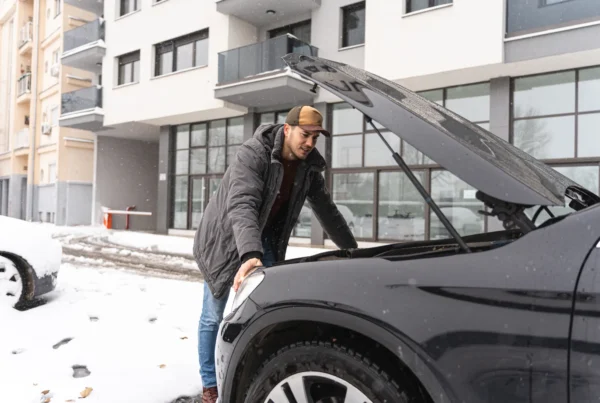
This is the check almost nobody does, and it takes two minutes. AAA suggests looking at underhood hoses monthly, and only on a cold engine. Coolant is under pressure and hot enough to burn badly, and there are moving parts up there. With the engine off and cool:
- Squeeze the radiator and heater hoses firmly, especially near the clamps. One that feels hard, or makes a faint crunching sound, is deteriorating and should be replaced.
- Watch for the opposite problem too. A hose that is extremely soft, sticky or soaked in oil is just as likely to fail.
- Look at the hose ends for dampness, crusty deposits, or dried coolant residue. That is a leak that only weeps when the system is hot, then dries as the car cools.
- Check for cracks, chafing, or rub marks where a hose contacts something else under the hood.
One check does require a warm engine. After a normal drive, park, shut it off and open the hood carefully. A collapsed upper radiator hose usually points at a faulty radiator cap, which a technician should test. Swollen or bulging sections anywhere mean internal damage.
A few symptoms mean stop driving now, not this weekend: a sweet burning smell, steam from under the hood, a temperature gauge into the red, or a leak large enough that the system will not hold a full coolant level.
Radiator Hose Repair in Williamsport, PA Starts with a Failure You Cannot See
Here is why the squeeze test beats the eyeball test.
The leading cause of coolant hose failure is electrochemical degradation, and it works from the inside out. The cooling system contains several different metals, the coolant carries a small electrical charge between them, and that charge attacks the hose. The damage is worst toward the ends, where the metal fittings are and the charge is strongest.
The cracks start on the inner wall, where you cannot see them. They work outward, coolant reaches the reinforcing layer, and the hose fails. From the outside, right up until it lets go, it looks fine.
So here is the tell: squeeze the ends and compare them to the middle. If the ends feel softer and spongier than the center, that hose is being eaten from the inside. Consumer Reports notes the upper radiator hose fails most often, followed by the water pump bypass and outlet heater hoses, and recommends squeezing near the clamps for exactly this reason.
Your Pennsylvania Inspection Sticker Does Not Cover This
This one surprises people, and the detail matters.
Pennsylvania’s annual safety inspection procedure is spelled out in state regulation, item by item: glazing, wipers, mirrors, lamps, shock absorbers, the steering column, the horn, the brakes, seats and safety belts, the defroster, hood latches, motor mounts, the fuel system, exhaust, the battery, tires and wheels, steering, suspension, frame, an emissions check and a road test.
Cooling system hoses are not on that list. Radiator and heater hoses are not on it. Serpentine and accessory drive belts are not on it either. The only belt and hose language in the whole procedure is brake-related: power brake hydraulic lines must not leak or be flattened, and a power brake booster must not have worn belts that keep its pump from working.
A valid sticker means your car met the state’s safety standard, not that anyone squeezed your upper radiator hose. If you are already getting ready for your Pennsylvania state inspection, ask for the belt and hose look while the car is there.
Belt and Hose Auto Repair in Bloomsburg, PA: What Our Technicians Check
When a car comes into any of our four Central PA shops for belt and cooling system work, the belt itself is only part of it.
On the belt side we look for glazing, where the contact surface has gone slick and shiny from slipping, and for pilling, where rubber has worn off onto the pulleys. Both usually point at low tension or a misaligned pulley rather than a bad belt. We look for oil contamination, and if we find it we find the leak that caused it. And we look at rib cracking: occasional widely spaced cracks are not an emergency, regular closely spaced ones are.
Then we check the tensioner. Most automatic tensioners carry a wear indicator that should sit inside a marked operating range. If it has drifted outside, the belt has stretched and needs replacing even if the ribs look perfect. We also spin the idler and tensioner pulleys by hand and listen for bearing noise, because loose bearings or misalignment will ruin a new belt quickly.
On the cooling side we squeeze every accessible hose at both ends and in the middle, check clamps and staining, check coolant level and the recovery tank, and test the cap. Then we tell you what we found. If you want a number before committing to anything, ask for a current quote on your vehicle.
A Practical Schedule for Central PA Drivers
You do not need a spreadsheet. You need a couple of habits.
- Once a month, pop the hood on a cold engine. Squeeze the hoses, glance at the belt, look for puddles or residue. Two minutes.
- Once before winter and once before summer, have someone who does this daily take the closer look, bundled into an oil change you were already booking. It slots in alongside the rest of a Central PA winter maintenance checklist.
- Track the years, not the miles. If you cannot remember when the belt or hoses were last done, and four birthdays have passed since, assume it is due.
AAA fielded more than 27 million roadside calls in 2024, and roughly 13 million ended in a tow. Their own managing director’s read was that a lot of those could have been avoided with maintenance. Belts and hoses sit squarely in that category: a little attention on a schedule, or an unplanned tow and a day you did not have to give up.
Bring It to Bastian
We have been doing this in Central Pennsylvania since 1958, and belts and hoses are the kind of unglamorous work that keeps people on the road. If you need auto repair in Bloomsburg, PA, or you are closer to our Williamsport, State College or Shamokin Dam stores, there is a shop within an easy drive.
If your car has more birthdays than its service records account for, or you have been hearing a chirp on cold mornings, let us look before the season turns. Ask us for a current quote and we will give you a straight answer on what it needs.