There is a moment every farmer in the Susquehanna Valley knows. You finish a pass, fold up, pull out of the gate, and put the machine on pavement for a few miles to the next field. Same tractor, same load, same tires. But everything those tires are being asked to do just changed, and the pressure that was exactly right in soft ground is now wrong.
That is the most common thing behind ruined farm tires coming through our shops in Bloomsburg, Shamokin Dam, State College and Williamsport. Not a nail, not a rock. Just a tire run at field pressure at road speed until the casing gave up.
Two Jobs, Two Pressures: What the Field Asks For and What Route 11 Asks For
In soft ground, low pressure is the whole point. The tire flattens out, puts more lugs on the ground, and spreads the weight over a longer footprint. You get traction and less soil compaction.
On pavement at transport speed, that same low pressure becomes a liability. Speed cuts a tire’s load-carrying capacity, so the faster the machine moves, the more air it needs under the identical weight.
AG Tire Talk gives an example of one tire model where the load and inflation table calls for 15 psi at a 5 mph field speed and 23 psi at a 40 mph transport speed, for the exact same load. Same tire, same weight, two very different answers, decided entirely by how fast you are going.
Pressure is set by load and speed together, not by load alone.
Why Air, Not Rubber, Carries the Load
Roughly 80% of any given load is carried by the compressed air inside the tire, not by the rubber and steel around it.
Once you accept that, pressure stops being a maintenance chore and becomes the load rating itself. Rubber is the container. Air is the structure. Run a tire 8 psi light and you no longer have the load rating you think you have.
That is also why “it looks fine” is not an inspection. An ag tire at field pressure looks squatty on purpose. You need a gauge and a table.
What Field Pressure Actually Does to a Tire on Route 11
The failure is rarely sudden, and it is almost never bad luck.
Roll a soft tire down four miles of Route 11 between Bloomsburg and Danville with a loaded spreader behind you. Every revolution, the sidewall squashes flat at the bottom and springs back at the top. At 5 mph in a field, that flexing happens slowly and the heat sheds. At road speed it happens fast, and heat builds inside the tire faster than it can escape.
Heat is what does the damage:
- The casing degrades from the inside. Excessive deformation breaks down the inner butyl rubber layer and wears the casing reinforcement. Bridgestone’s agricultural division is blunt about where that ends: the tire fails at the carcass ply, and replacement is the only option.
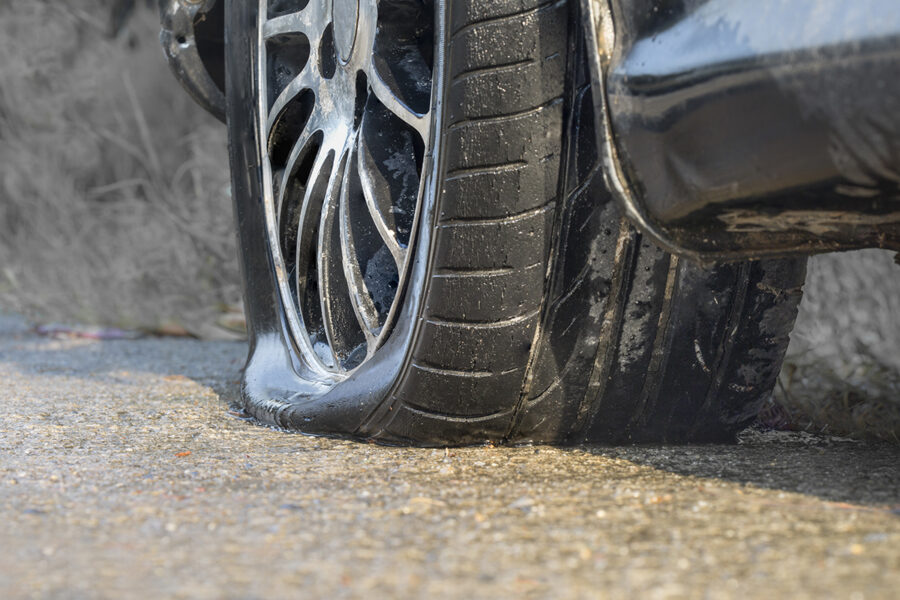
- Sidewall flex triggers sudden punctures. That internal heating can cause a tire to let go during highway driving, especially where the casing is already weakened by months of running light.
- The bead can lose its grip on the rim. Too little air means too little bead seating force. If the rim turns and the tire does not come with it, you get bead slip, which makes its own heat and can tear a valve stem out of a tube.
- The sidewall rides down where the road is. Under-inflated, the lower sidewall bulges toward whatever is on the shoulder. The same road hazards and everyday debris that threaten a pickup tire are far more dangerous to a soft ag sidewall.
The quiet costs add up long before anything dramatic happens. On abrasive surfaces, running under-inflated shortens service life by 25% through abnormal shoulder and lug wear. Fuel consumption climbs by up to 5% overall, with bigger losses on extended road travel.
Watch the wear pattern. Worn shoulders with a healthy tread center is the signature of months at too-low pressure.
How to Read a Load and Inflation Table Without Guessing
Every ag tire manufacturer publishes load and inflation tables. They are the authority here, not a rule of thumb and not what worked on the last tractor. To use one, you need three real inputs.
- The exact tire size and construction off the sidewall. Not “the big ones on the back.” The full stamp, including radial or bias and any IF or VF marking.
- The actual weight on each axle, field-ready. Weighed with the implements attached and the machine loaded the way it really works. Divide the axle load by the number of tires on that axle and you have load per tire, which is what the table is indexed on.
- The top speed the machine will actually travel. Not its average. The fastest thing it does all week.
Then set inflation for the highest speed the machine will run while carrying that weight. That one setting has to be safe in the field and safe on the highway between fields. If you only set for field speed, every road trip is an overload.
For a lot of Pennsylvania operations, that is more road time than people realize. USDA figures put the state at about 48,400 farm operations working 7.1 million acres, an average of 147 acres apiece. Around Columbia, Snyder, Union, Centre and Lycoming counties that means scattered small parcels and short hops on pavement, over and over.
Radial, Bias, IF and VF: Choosing Agricultural Tires for Susquehanna Valley Roads
Construction determines which pressures are even available to you, so it comes before the pressure decision.
Radials build a larger, more uniform footprint, cut soil compaction, and ride better. According to CEAT Specialty, they deliver roughly 30% longer service life than bias tires.
Bias-ply tires are simpler and stiffer, and they still make sense for some implements and lighter-duty machines. They do not give you the smooth, stable highway behavior of a radial.
IF and VF radials are worth a look if road travel is a real part of your week. IF (increased flexion) tires carry about 20% more load than a standard radial at the same pressure, and VF (very high flexion) tires carry about 40% more. Read that the other way around: they let you carry the load you actually have at a lower pressure.
If you are shopping agricultural tires in the Susquehanna Valley, tell us how the machine splits its week and the construction choice usually makes itself.
Ballast and Liquid Fill: Decide It Together With Pressure
Change your ballast and you have changed what your pressure should be.
Liquid fill is the traditional Central PA answer for weight and grip. Standard practice fills to about 75% of tire capacity, which is valve level with the valve at 12 o’clock. A 40% fill, to the four o’clock position, is used when a softer ride and better power hop control matter more than maximum weight.
But liquid fill and radials argue with each other. Putting liquid ballast in a radial stiffens the sidewall and narrows the footprint. One dealer’s summary, quoted in Modern Tire Dealer, is that it “turns it into a bias-ply tire,” defeating the fuel savings, drawbar pull and ride you bought radials for. Firestone’s engineering manager in that same piece says calcium chloride is not recommended in radials because of power hop.
If you run calcium chloride, mixture strength is about 3.5 pounds per gallon of water in cold climates and up to 5 pounds per gallon where it gets extremely cold. Rims run without tubes need rinsing immediately after the tire is demounted, or corrosion moves fast. Cast iron and suitcase weights are the alternative.
How do you know if your ballast is right? Wheel slip is the feedback signal. Tractors and tires should run with wheel slippage in the 10% to 15% range. Below that and you are hauling weight you do not need. Above it and you need more ballast or a pressure correction.
Repairable, or Is the Casing Done?
This is the question we get asked most at the counter, and some answers are not a judgment call.
Replace it. Do not repair it:
- A sidewall bulge. The casing is damaged underneath. It cannot be repaired and it can fail at any time.
- Any cut, tear or puncture that exposes the body plies or belts. Those are the tire’s structure. Once they are open to the road, the tire is finished.
- Dry rot. However good the tread looks, a tire with dry rot needs replacing. This one catches hobby-farm owners out, because a machine that sits gets old on the calendar, not on the hour meter.
- A casing that already failed at the ply from chronic under-inflation. By then there is nothing left to fix.
Usually repairable: a clean puncture in the tread area on a casing that is otherwise sound and has not been run flat.
The gray zone is the tire you keep topping up every week. A chronic slow leak may be a bead seating issue, a valve, a rim problem, or a casing that is weeping. Worth diagnosing, because the week you forget to top it up is the week the damage happens.
Some of this can only be judged once the tire is off the rim, which is the same reason an estimate can change once the wheels come off on a car.
Cost is the natural next question, and it is the one thing we will not put in a blog post. Ag tire and labor pricing moves, and a stale number helps nobody. Send us the size and a photo and ask for a current quote, and we will price the actual job on your machine.
The Pennsylvania Road Rules That Frame All of This
Under Pennsylvania Vehicle Code section 4529, implements of husbandry designed to operate at 25 mph or less must display a slow-moving vehicle emblem on highways. Penn State Extension describes the standard: a fluorescent red-orange triangle with a red retroreflective border, mounted 2 to 10 feet above the ground and visible up to 1,000 feet day or night. Pennsylvania also requires a flashing yellow beacon, plus two white headlights, two red taillights, and amber hazard flashers running at 60 to 85 flashes per minute.
That fluorescent orange center fades with sun exposure, going yellow, pink or even white. Replace the emblem when the color goes.
Put the two halves together. A 25 mph machine on Route 11, US 15 north of Shamokin Dam, or Route 45 out toward State College is already the slowest thing on the road, with cars closing at highway speed. That is the worst possible place to have a tire let go, and it is exactly the situation field pressure on pavement sets up.
What to Bring Us for Tractor Tire Service in Central PA
Good tractor tire service in Central PA starts with good information. Bring these and we can do the lookup while you are standing there.
- A photo of the sidewall stamp. Full size, ply or load index, speed marking, and any IF or VF designation.
- Axle weights, field-ready. Machine plus the implements you actually run. A scale ticket is ideal.
- What implements go on it, and how heavy they are loaded. A full spreader and an empty one are different tires’ worth of load.
- How much pavement you cover and how fast. A mile down a township road twice a year is a different setup than daily runs on Route 11.
- Your current ballast setup. Liquid fill and roughly what percentage, cast weights, or nothing.
- A photo of the damage, if that is why you are calling.
That list is the same for a high-horsepower tractor, a harvester, a sprayer, a cultivator or a farm trailer. We handle agricultural tires across the Susquehanna Valley for farmers, landscapers and commercial operations.
Check It Before the Season, Not After the Blowout
Farm tire repair in Bloomsburg PA and at our other three shops follows a pattern. The tires that arrive on a trailer, ruined, are almost always the ones that spent a season a few psi light on pavement. The ones that stay in service are the ones somebody put a gauge on twice a year.
Pick two points on the calendar, before spring work and before harvest. Check pressure cold, and walk the sidewalls looking for bulges, cuts and cracking.
With harvest under way across the valley this fall, now is the sensible time to look. Bastian Tire & Auto Centers has been doing honest work in Central Pennsylvania since 1958, and we would rather set your pressures right before the wagons are loaded than sell you a casing in the middle of the season. Schedule an appointment at whichever of our four locations is nearest your operation, and bring the weights.